
Here's what you need to know:
-
What data is collected? AI systems gather personal information like contact details, browsing history, location data, and even sensitive patterns like behaviour and preferences.
-
Why does it matter? This data can be stored for years, shared with third parties, or used to make decisions about you - sometimes without your consent.
-
What are the risks? Cybercrime is on the rise, with AI cracking passwords and exposing sensitive information faster than ever. Recent incidents, like Meta's €1.2 billion GDPR fine, highlight the consequences of mishandling data.
-
How can you protect yourself? Use strong passwords, enable multi-factor authentication, review privacy settings, and limit data sharing.
Quick Overview of AI Privacy Risks:
| Risk | Example | Prevention |
|---|---|---|
| Pattern Recognition | Reveals habits and routines | Limit data sharing |
| Profile Building | Creates detailed psychological profiles | Regularly update privacy settings |
| Password Cracking | AI cracks 51% of passwords in 1 min | Use long, complex passwords |
| Data Retention | Stored for up to 3 years | Use GDPR-compliant services |
AI offers incredible potential but comes with significant privacy challenges. Stay informed and take proactive steps to protect your data.
AI Privacy Policies: ChatGPT, Gemini, and Claude Compared – What You Need to Know!
Personal Data Types in AI Systems
Under GDPR, personal data includes any information that can directly or indirectly identify an individual. Since AI systems process enormous amounts of personal data, having clear classifications is crucial.
GDPR Personal Data Guidelines
The GDPR framework divides personal data into two main categories: general and special (sensitive) data. Special category data requires stricter safeguards because of its potential impact on individual privacy and rights.
| Data Category | Examples | Protection Level |
|---|---|---|
| General Personal Data | Name, Email, Phone number, IP address | Standard GDPR protection |
| Special Category Data | Health records, Biometric data, Religious beliefs | Enhanced protection required |
| Criminal Data | Criminal records, Offence data | Strict limitations apply |
Recent cases underline the risks of mishandling personal data. In January 2023, Meta faced a €390 million fine from Ireland's Data Protection Commission due to insufficient transparency about its data processing practices on Facebook and Instagram [4]. Similarly, H&M was fined €35.3 million in Germany for over-collecting employee data [4].
"Personal data are any information which are related to an identified or identifiable natural person." - GDPR-info.eu [3]
These rules are the foundation for understanding how AI systems, like Gemini, handle personal data.
How AI Uses Your Data
AI systems, such as Gemini, often engage in detailed data collection and retention. As reported by Surfshark [6], the scope of personal data processing in AI systems is extensive.
Some key retention practices include:
-
Google retains Gemini Apps activity for up to 18 months by default [1].
-
Conversations reviewed by humans are stored for as long as three years [1].
-
30% of chatbot apps analysed share user data with third parties [6].
"AI chatbot apps can go even further by processing and storing conversations." - Tomas Stamulis, Chief Security Officer at Surfshark [6]
GDPR violations can result in penalties of up to €20 million or 4% of a company’s global annual turnover [4]. To comply, AI systems must adopt robust measures, such as limiting data collection, ensuring purpose-specific use, securing sensitive information, obtaining clear consent, and conducting thorough data protection impact assessments.
As AI continues to evolve, balancing technological advancements with privacy protections becomes increasingly important. Safeguarding personal data is not just a legal requirement - it’s a responsibility that grows more critical as these systems advance.
Privacy Risks When AI Processes Your Data
AI systems have become deeply embedded in our digital lives, but their growing capabilities also bring heightened privacy concerns. These risks go far beyond traditional cybersecurity threats, reshaping how we think about data protection.
Hidden Data Analysis by AI
AI has an uncanny ability to extract sensitive details from seemingly harmless data, creating a new layer of privacy challenges. Take the 2016 Cambridge Analytica scandal, for example. Through a simple personality quiz app, data from over 87 million Facebook users was collected and used to create psychological profiles for targeted political ads during the US Presidential Election [8]. Similarly, in 2018, the fitness app Strava inadvertently exposed military base locations and patrol routes via its "heatmap" feature, showcasing user activity patterns [8].
| AI Analysis Risk | Potential Impact | Prevention Measure |
|---|---|---|
| Pattern Recognition | Reveals behavioural habits and routines | Limit data sharing across applications |
| Profile Building | Creates detailed psychological profiles | Regularly review privacy settings |
| Location Tracking | Exposes sensitive location data | Use VPNs and location masking tools |
| Cross-Platform Analysis | Combines data from multiple sources | Opt out of cross-app tracking |
AI’s ability to uncover hidden patterns is just one concern. It also poses a direct threat to password security.
Password Security in AI Systems
AI has made traditional password protection far less reliable. Research from Kaspersky revealed that AI algorithms can crack 87 million passwords in under a minute [11]. Tools like PassGAN are particularly alarming, with the ability to break 51% of common passwords in just 60 seconds [7].
Here’s how quickly AI systems can compromise passwords:
-
51% cracked in under one minute
-
71% compromised within 24 hours
-
81% broken within one week [10]
To counteract these risks, stronger security practices are essential. Use passwords that are at least 15 characters long, mixing uppercase and lowercase letters, numbers, and symbols [9]. Multi-factor authentication adds another crucial layer of protection, significantly reducing the effectiveness of AI-driven attacks.
The consequences of lax security can be severe. In January 2023, Yum! Brands fell victim to an AI-powered ransomware attack, forcing the closure of 300 UK branches for weeks [2]. Similarly, in December 2023, an AI-generated phishing SMS breached Activision’s employee database [2].
These incidents highlight the urgent need for robust security measures, especially when AI systems handle sensitive data. The financial toll is staggering, with the average data breach costing around €3.54 million and taking organisations approximately 280 days to detect and contain [12].
sbb-itb-a5875d1
Data Privacy Laws for AI
In Belgium and across the EU, two major frameworks govern data protection in AI systems: the General Data Protection Regulation (GDPR) and the EU AI Act.
GDPR Rules for AI
Under GDPR, AI systems are required to process data in a way that is fair, transparent, and strictly aligned with specific purposes. Non-compliance can lead to steep fines:
-
Up to €10 million or 2% of annual revenue for less severe breaches
-
Up to €20 million or 4% of annual revenue for more serious violations [16]
By January 2025, European authorities had already imposed around €5.88 billion in GDPR fines [17]. A notable example is Meta's €1.2 billion penalty in May 2023, issued by the Irish Data Protection Commission for failing to adequately safeguard European users' data during transfers to the US [17]. This case highlights the critical importance of robust AI data management.
| GDPR Requirement | AI Implementation |
|---|---|
| Purpose Limitation | AI systems must use data only for clearly defined purposes |
| Data Minimisation | Collect only the data that is absolutely necessary |
| Transparency | Ensure users understand how their data is processed |
| Security Measures | Implement encryption and strict access controls |
| User Rights | Allow users to access, correct, and delete their data |
These GDPR principles form a solid foundation for the additional regulations introduced by the EU AI Act.
EU AI Act Data Protection
The EU AI Act builds on GDPR by introducing stricter rules for high-risk AI applications. It complements GDPR by addressing specific scenarios where AI systems handle personal data.
"The EU AI Act and the GDPR are designed to work hand-in-glove, with the latter 'filling the gap' in terms of individual rights for scenarios where AI systems use data relating to living persons." - Privacy Matters [5]
The Act enforces a tiered penalty system:
| Violation Type | Maximum Fine |
|---|---|
| Prohibited AI Practices | €35 million or 7% of annual turnover |
| General Non-compliance | €15 million or 3% of annual turnover |
| Misleading Information | €7.5 million or 1% of annual turnover |
In addition to these penalties, the Belgian Data Protection Authority requires organisations to take proactive steps, including:
-
Conducting Data Protection Impact Assessments for high-risk AI processes
-
Ensuring human oversight throughout the AI system's lifecycle
-
Establishing documented cybersecurity policies
-
Performing regular risk assessments
-
Developing clear incident response procedures [15]
Belgium aims to balance its ambition to become a hub for AI innovation with its commitment to rigorous data protection standards [14]. The EU AI Act officially came into effect on 2 February 2025, with an immediate ban on AI systems deemed to pose unacceptable risks [13].
Secure Password Management with AI
AI is reshaping how organisations manage passwords. By using AI-driven security tools, companies have been able to cut breach detection times by an impressive 108 days and save an average of €1.62 million in response costs [21].
Preventing AI Data Leaks
AI-powered systems are designed to guard against data leaks and unauthorised access. These tools continuously monitor user activity, analysing access patterns and adjusting security protocols in real-time [18].
However, even with advanced tools, mistakes happen. In early 2025, Microsoft's AI research team accidentally exposed 38 TB of private data due to a misconfigured cloud storage system [20]. This incident underscores the importance of implementing strong security practices. Here's how AI enhances key security layers:
| Security Layer | AI-Enhanced Protection |
|---|---|
| Access Control | Real-time behaviour monitoring and anomaly detection |
| Data Encryption | Adaptive encryption strength based on threat levels |
| Authentication | Multi-factor verification with behavioural biometrics |
| Monitoring | Continuous analysis of access patterns and threat detection |
As Patrick Spencer, Spokesperson at Kiteworks, puts it:
"Ensuring data security and privacy is essential when utilizing LLMs and generative AI tools. With rigorous data privacy regulations across regions and industries, it's imperative to use anonymized and encrypted data to mitigate risks." [19]
These strategies highlight how AI-driven tools are evolving to address the complex challenges of data security.
Hypervault Security Features
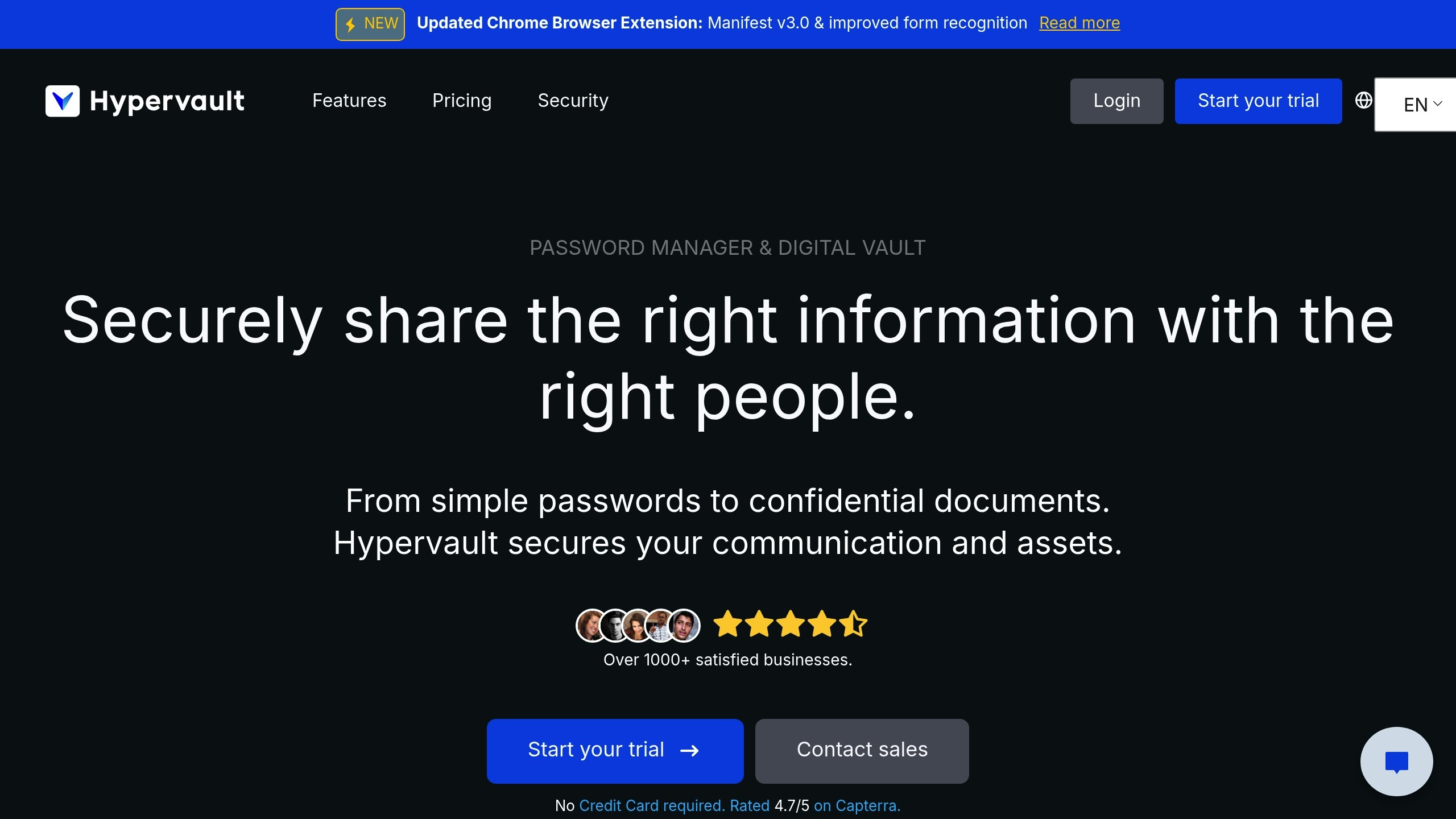
Hypervault builds on these advanced AI techniques to provide a comprehensive, EU-based data protection system. With strict adherence to GDPR and a focus on end-to-end encryption, Hypervault offers a robust security framework designed to meet the needs of modern organisations.
-
Secure Data StorageSensitive data is stored exclusively in EU-based data centres, ensuring compliance with regional privacy laws. Military-grade encryption is applied to both stored and transmitted data.
-
Access Control ManagementHypervault's workspace management tools allow for precise control over data access. Key features include:
Custom data templates to standardise security protocols
-
Integration with Microsoft Azure for enhanced enterprise-level security
-
Automated logging and monitoring of data access
- Secure Sharing CapabilitiesThe platform enables safe file sharing with privacy-focused features such as:
End-to-end encryption for file transfers
-
Customisable access permissions
-
Secure document sharing with expiration dates
-
Automated enforcement of security policies
With over 77% of companies now using or exploring AI, it's worth noting that more than three-quarters have reported AI-related security breaches [19]. Hypervault’s advanced security measures, including strong password generation, help organisations protect sensitive data while maximising the benefits of AI.
Conclusion
With AI systems becoming more intertwined with personal data, the need to safeguard privacy has never been greater. To address this, modern AI systems now incorporate layered security measures to protect internal data effectively [22]. However, as AI-driven threats grow more advanced, adopting a thorough and proactive approach to security is critical.
One essential aspect of this is implementing strong security protocols. Effective password management plays a major role here, encompassing tools like end-to-end encrypted password managers, multi-factor authentication, and routine privacy audits. As Keri Pearlson, Executive Director of cybersecurity research at MIT Sloan, explains:
"Password managers are an important component of how we need to manage our personal security. They are designed to be used in a way that reduces our efforts to be secure, but still helps us keep our important information secure." [23]
The financial and personal risks of inadequate security highlight the importance of solid defences. A combination of strategies is necessary to counter AI-driven threats effectively. Here’s a quick overview of the key protection measures:
| Security Layer | Key Protection Measures |
|---|---|
| Access Control | Multi-factor authentication, behavioural biometrics |
| Data Privacy | EU-based storage, GDPR compliance |
| Password Security | Strong password policies, regular updates |
| AI Integration | Real-time threat detection, automated security protocols |